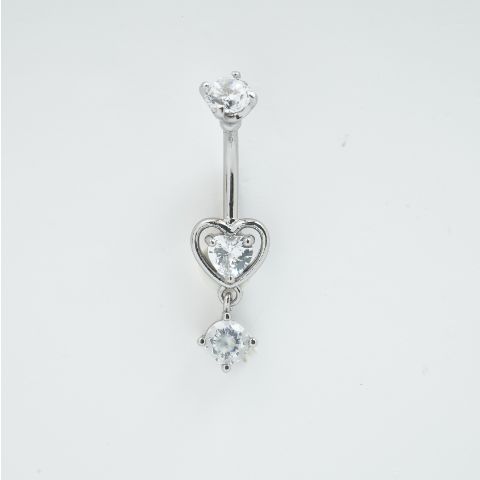

Photos from current listings. Actual item, color, and included accessories may vary.
Curved Barbell Jewelry Buying Guide
Curved barbells are a staple body piercing shape, defined by a bent bar with threaded or threadless ends, used across eyebrow, rook, daith, septum, and surface piercings. The core trade-off is material grade and threading architecture: implant-grade titanium (ASTM F136) in threadless or internal-thread designs resists corrosion and reduces insertion trauma, while inexpensive 316L surgical steel or externally threaded bars can raise rejection and migration risk. The decision rule is simple: prioritize ASTM F136 titanium or 14k+ solid gold with internal/threadless ends for healing and long-term wear, and avoid externally threaded, plated, or mystery-metal bars for anything but short-term costume use.
Key takeaways
- Material standard: ASTM F136 Ti-6Al-4V ELI (implant-grade titanium) is the gold standard for initial piercings; 316LVM steel is acceptable but heavier and less bio-friendly.
- Threading architecture: internal-thread and threadless (push-pin) designs minimize the exposed thread that can scrape fistula tissue during insertion—external threads are the most traumatic.
- Gauge and length system: standard curved barbell gauges run 14G (1.6mm), 16G (1.2mm), and 18G (1.0mm); lengths from 1/4" to 1 1/2" dictate fit for eyebrow, rook, and surface placements.
At a glance
- Category
- Body Jewelry
- Last updated
- Nov 28, 2026
Current offers
Highlights
- Material standard: ASTM F136 Ti-6Al-4V ELI (implant-grade titanium) is the gold standard for initial piercings; 316LVM steel is acceptable but heavier and less bio-friendly.
- Threading architecture: internal-thread and threadless (push-pin) designs minimize the exposed thread that can scrape fistula tissue during insertion—external threads are the most traumatic.
- Gauge and length system: standard curved barbell gauges run 14G (1.6mm), 16G (1.2mm), and 18G (1.0mm); lengths from 1/4" to 1 1/2" dictate fit for eyebrow, rook, and surface placements.
- End/ball sizing: ball diameters typically range 2.5mm–6mm; smaller balls suit rook/daith and reduce snagging, while 4mm+ balls are common for eyebrow and industrial-adjacent looks.
Best use cases
- Healing a new eyebrow or rook piercing: choose 16G ASTM F136 titanium with threadless or internal-thread ends and a ball diameter of 3mm or less to minimize snagging and irritation.
- Established septum or daith piercing: 16G or 18G implant-grade titanium curved barbell with 2.5–3mm ends; skip surgical steel if you have nickel sensitivity.
- Surface or anti-eyebrow piercing: 14G internal-thread titanium with longer bar (3/8"–1/2") and flat-disc ends to reduce pressure; avoid externally threaded bars that catch on clothing.
- Costume or short-wear fashion (non-healing piercings): 316L steel or plated brass is acceptable only for healed, low-risk placements—never for fresh or cartilage piercings.
Buying tips
- Match gauge to piercing type: 14G for surface/industrial-adjacent, 16G for eyebrow/rook/daith, 18G for delicate septum or nostril-adjacent curves; downsizing after healing reduces migration.
- Length formula: measure the straight-line distance between piercing holes and add 1–2mm for initial swelling; a too-long bar causes snagging, a too-short bar causes embedding.
- Threading preference: threadless (push-fit) ends allow tool-free changes and smoother insertion; internal thread requires a compatible insertion taper and is more secure for high-movement areas.
- Material verification: look for ASTM F136 or ASTM F138 markings; avoid "surgical steel" without grade, and never use sterling silver or plated metals in fresh piercings due to tarnish and toxicity.
Specs
| Material Grade | ASTM F136 Ti / 316LVM steel / 14k gold |
|---|---|
| Threading Style | Internal / Threadless / External |
| Gauge Range | 18G–14G (1.0–1.6mm) |
| Bar Length | 1/4"–1 1/2" (6–38mm) |
Related searches
What to check before buying
- Confirm your piercing gauge and length with a piercer or caliper—curved barbells are not one-size-fits-all and a 1mm length error changes fit significantly.
- Verify material certification: request ASTM F136 titanium or 14k+ solid gold; 316L steel is acceptable only if nickel-free and fully healed.
- Check end compatibility: threadless ends require a compatible pin gauge (typically 25G or 26G pin); internal-thread ends must match the bar's internal thread pitch (commonly 1.2mm or 0.9mm).
- For high-movement or surface piercings, choose flat-disc or bezel-set ends over balls to reduce snagging and pressure necrosis risk.
FAQ
Data sources: eBay / Amazon listings and product attribute feeds. Updated Nov 28, 2026.
Some links on this page are affiliate links. If you buy after clicking one, we may earn a commission at no extra cost to you. This does not change which products appear here or their order. Affiliate disclosure.