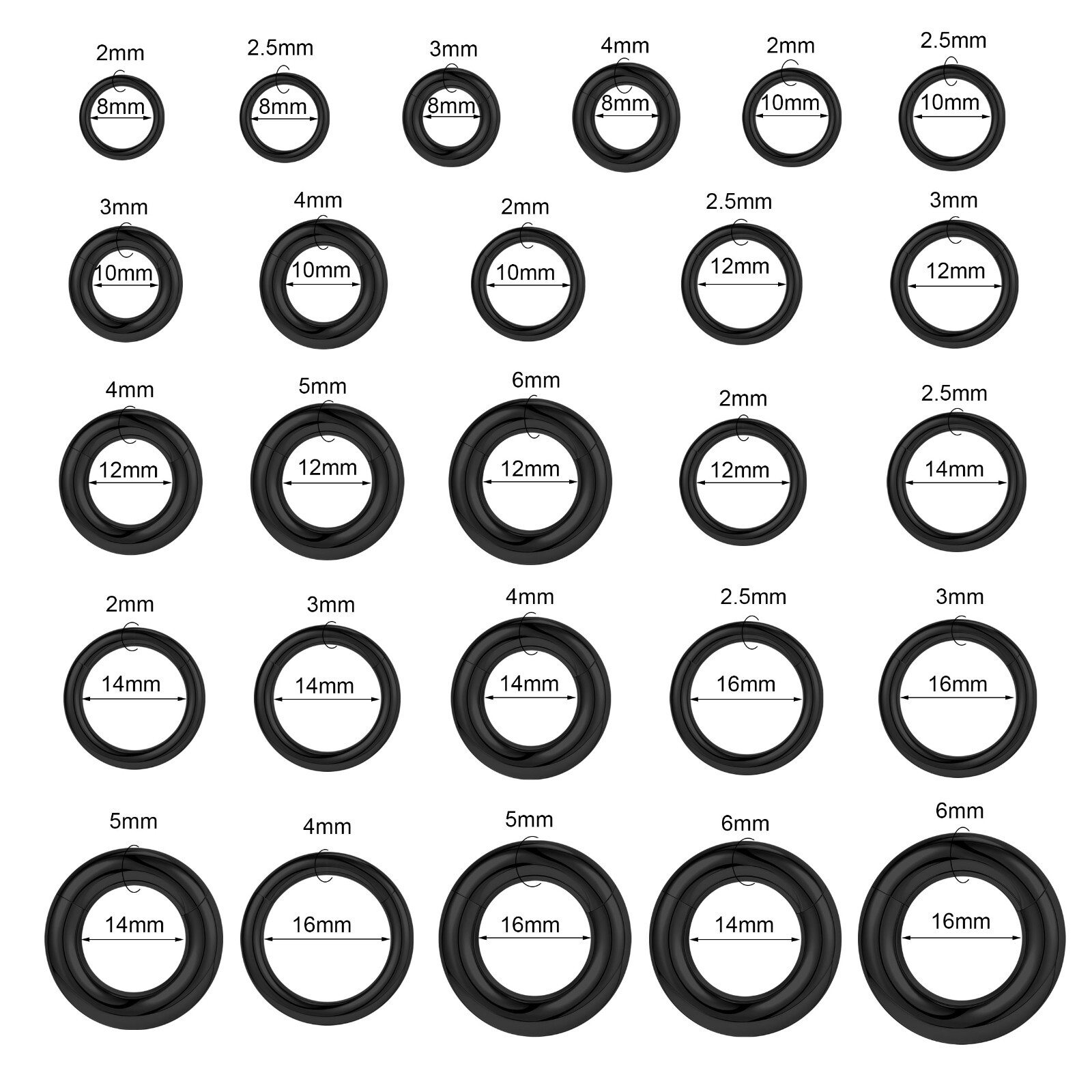

Photos from current listings. Actual item, color, and included accessories may vary.
Earring Hoop Jewelry Making Buying Guide
Earring hoop jewelry making means selecting pre-formed or formable hoop components—wire, clickers, seam rings, and gauge hoops—to build finished earrings, with the core trade-off between material metallurgy (implant-grade titanium/G23 vs. plated brass) and closure architecture (hinged clicker vs. seam vs. bead ring) that determines both skin safety and daily durability. The clear decision rule: if the hoop will be worn in a fresh or sensitive piercing, buy only ASTM F136 titanium or nickel-free 316LVM with a smooth clicker or captive seam; if it is a decorative fashion hoop, plated brass or 304 stainless is acceptable only with a sealed coating.
Key takeaways
- Implant-grade titanium per ASTM F136 (Ti-6Al-4V ELI) is the benchmark for piercing-safe hoops; G23 is a marketing label for the same alloy, not a separate grade.
- Hinged clicker mechanisms use a spring-loaded bar that snaps into a channel; seam rings rely on a tension gap and are more prone to snagging and bending during insertion.
- Gauge sizing for hoops follows the Birmingham/imperial wire gauge: 2G = 6.5 mm, 12G = 2.0 mm, 16G = 1.2 mm, 18G = 1.0 mm, 20G = 0.8 mm wire thickness.
At a glance
- Category
- Body Jewelry
- Last updated
- Nov 28, 2026
Current offers
Highlights
- Implant-grade titanium per ASTM F136 (Ti-6Al-4V ELI) is the benchmark for piercing-safe hoops; G23 is a marketing label for the same alloy, not a separate grade.
- Hinged clicker mechanisms use a spring-loaded bar that snaps into a channel; seam rings rely on a tension gap and are more prone to snagging and bending during insertion.
- Gauge sizing for hoops follows the Birmingham/imperial wire gauge: 2G = 6.5 mm, 12G = 2.0 mm, 16G = 1.2 mm, 18G = 1.0 mm, 20G = 0.8 mm wire thickness.
- Hoop inner diameter must exceed tissue thickness by at least 2–3 mm; a 8 mm inner diameter fits most healed lobe piercings, while cartilage and septum need 10–12 mm minimum to avoid pressure necrosis.
Best use cases
- Best fit: healed lobe piercings with 18G–20G wire and 8–10 mm inner diameter in ASTM F136 titanium clickers—buy this tier for daily wear and sleep-safe comfort.
- Best fit: stretched or gauge ear projects using 2G–12G titanium hinged septum/ear hoops—pick single-flare or clicker styles with mirror-polished interiors to reduce friction during insertion.
- Wrong fit to skip: plated brass or 304 stainless seam rings for fresh piercings—nickel leaching and rough seam edges cause irritation; use only for healed, non-sensitive fashion wear.
- Wrong fit to skip: oversized 12 mm+ inner diameter hoops on thin lobes—they shift, catch on hair, and migrate; choose diameter based on measured tissue thickness, not aesthetics alone.
Buying tips
- Match wire gauge to piercing age and location: 20G–18G for healed lobes, 16G for cartilage and nostril, 14G–12G for septum and stretched lobes; never downsize below the piercing's established gauge without a taper.
- Calculate inner diameter as tissue thickness + 2 mm minimum clearance; measure the piercing channel with a caliper or use the existing jewelry's inner diameter as a baseline, then add 1–2 mm for swelling allowance.
- Choose closure by wear scenario: hinged clickers for frequent changes and high-movement areas; captive bead rings for secure long-term wear; seam rings only for low-friction, healed piercings.
- Verify material certification: demand ASTM F136 or ISO 5832-3 for titanium, and 316LVM (not 316L) for surgical steel; avoid unspecified 'titanium' listings without mill certificates for body wear.
Specs
| Metal Grade | ASTM F136 Ti / 316LVM steel |
|---|---|
| Wire Gauge Range | 20G–18G lobes; 16G–12G body |
| Closure Type | Hinged clicker / seam / captive |
| Inner Diameter | 8–10 mm lobe; 10–12 mm body |
Related searches
What to check before buying
- Measure the piercing channel thickness with a caliper or gauge wheel before selecting inner diameter; add 2 mm for healed tissue and 3 mm for cartilage or fresh piercings.
- Confirm the hoop's wire gauge matches the piercing's current gauge; inserting a thicker wire into an unstretched piercing causes micro-tears and delayed healing.
- Check the closure mechanism's internal finish: mirror-polished or electropolished surfaces reduce bacterial adhesion and insertion friction; reject rough seam gaps or visible weld lines.
- Verify the metal meets ASTM F136 (titanium) or 316LVM (steel) and is nickel-free for sensitive skin; plated brass and 304 stainless are decorative-only and not for prolonged body wear.
FAQ
Data sources: eBay / Amazon listings and product attribute feeds. Updated Nov 28, 2026.
Some links on this page are affiliate links. If you buy after clicking one, we may earn a commission at no extra cost to you. This does not change which products appear here or their order. Affiliate disclosure.