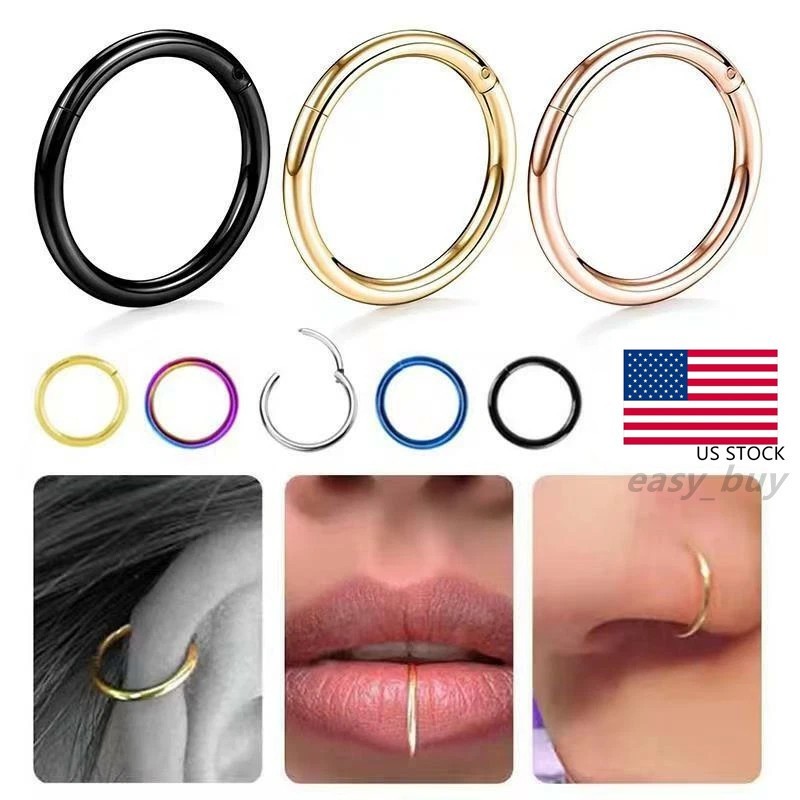

Photos from current listings. Actual item, color, and included accessories may vary.
Hoop Body Jewelry Buying Guide
Hoop body jewelry covers continuous rings used in lip, ear, nose, septum, eyebrow, and other body piercings, where the key trade-off is material biocompatibility and closure security versus low-cost fashion finishes. Durable options use implant-grade titanium (ASTM F136) or 316L stainless steel with a positive-locking hinge or captive bead; compromises use mystery metals, plated brass, or friction-fit seams that loosen.
Key takeaways
- Implant-grade titanium (ASTM F136) is lighter and nickel-free; 316L surgical steel (ASTM F138) is heavier and can contain trace nickel that irritates sensitive skin.
- Hinged segment rings use a spring-loaded clicker closure for tool-free changes; captive bead rings use a tension-fit bead that can pop out if the ring is bent.
- Gauge and inner diameter are independent: a 16G (1.2mm) wire with a 3/8" (10mm) inner diameter is standard for healed lip and cartilage hoops; 18G (1mm) suits nose and eyebrow.
At a glance
- Category
- Body Jewelry
- Last updated
- Nov 28, 2026
Current offers
Highlights
- Implant-grade titanium (ASTM F136) is lighter and nickel-free; 316L surgical steel (ASTM F138) is heavier and can contain trace nickel that irritates sensitive skin.
- Hinged segment rings use a spring-loaded clicker closure for tool-free changes; captive bead rings use a tension-fit bead that can pop out if the ring is bent.
- Gauge and inner diameter are independent: a 16G (1.2mm) wire with a 3/8" (10mm) inner diameter is standard for healed lip and cartilage hoops; 18G (1mm) suits nose and eyebrow.
- Threadless or internally threaded ends reduce insertion trauma versus externally threaded posts that drag bacteria through the fistula.
Best use cases
- Best fit: healed lobe, cartilage, lip, or septum piercings where you want a secure, tool-free clicker in 16G or 18G implant-grade titanium; skip plated or mystery-metal hoops for fresh or sensitive piercings.
- Best fit: nostril and eyebrow hoops in 20G–18G with a small inner diameter (5/16"–3/8") for a snug fit; skip thick 14G seamless hoops for these thinner areas.
- Best fit: daily-wear sleepers and work-safe minimal hoops in 316L steel or titanium with a smooth hinge; skip bulky captive-bead rings if you frequently remove jewelry or wear tight helmets/headphones.
- Wrong fit: fresh piercings during healing—hoops rotate and introduce bacteria; use straight or curved barbells until fully healed, then switch to a hoop.
Buying tips
- Match gauge to piercing: 20G (0.8mm) nostril, 18G (1mm) eyebrow/nose/septum, 16G (1.2mm) lip/cartilage/lobe, 14G (1.6mm) navel/industrial—never force a thicker wire into a healed hole.
- Choose inner diameter so the hoop sits snug but not tight: measure the piercing channel and add 1–2mm clearance; standard sizes are 5/16" (8mm), 3/8" (10mm), and 1/2" (12mm).
- Prioritize ASTM F136 titanium or 316L steel with a mirror-polished finish; avoid brass, copper, or plated zinc alloys that tarnish and leach into the fistula.
- For clickers, confirm a captive hinge with a defined click detent; for seamless hoops, look for a flush-fit seam that will not catch on fabric or hair.
Specs
| Material Grade | ASTM F136 titanium / 316L steel |
|---|---|
| Gauge Range | 20G (0.8mm) to 14G (1.6mm) |
| Closure Type | Hinged clicker / captive bead / seamless |
| Inner Diameter | 5/16" (8mm) to 1/2" (12mm) |
Related searches
What to check before buying
- Confirm your piercing gauge with a caliper or a piercer—common sizes are 20G, 18G, 16G, and 14G; buying the wrong gauge causes irritation or loss.
- Measure the inner diameter of your current jewelry and match it, or size up 1mm for swelling-prone areas like cartilage and septum.
- Check material certification: implant-grade titanium should state ASTM F136; steel should state 316L or ASTM F138.
- For nose and lip hoops, verify the closure type is secure for your daily routine (clicker vs captive bead vs seamless) and that the ring will not interfere with glasses, masks, or sleep.
FAQ
Data sources: eBay / Amazon listings and product attribute feeds. Updated Nov 28, 2026.
Some links on this page are affiliate links. If you buy after clicking one, we may earn a commission at no extra cost to you. This does not change which products appear here or their order. Affiliate disclosure.