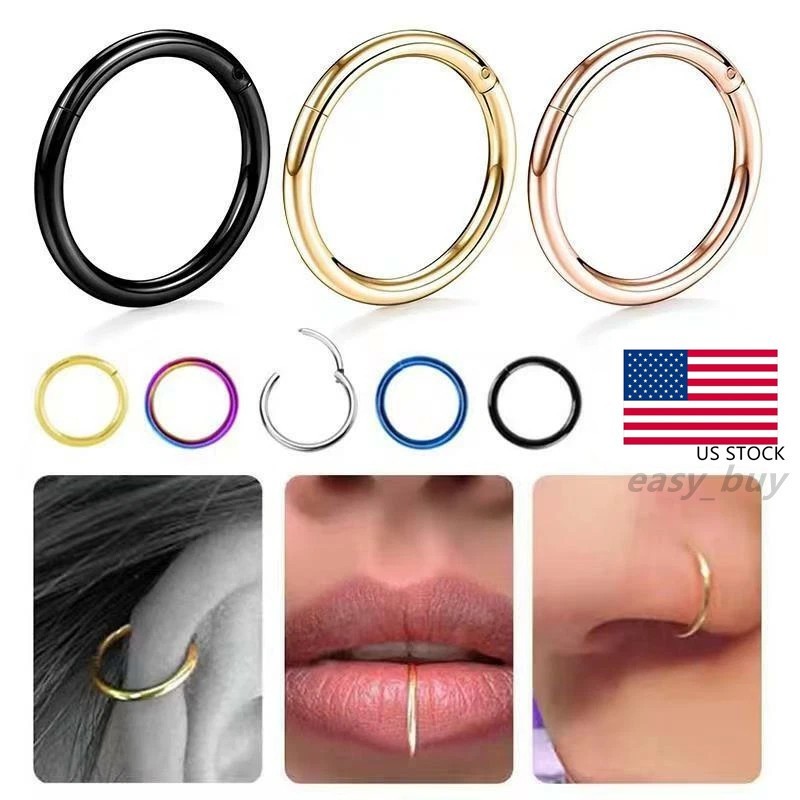

Photos from current listings. Actual item, color, and included accessories may vary.
Nose Piercing Ring Buying Guide
Nose piercing rings are circular body-jewelry hoops or seamless rings worn in nostril, septum, and other facial piercings, where the critical trade-off is between implant-grade materials and a secure, comfortable closure mechanism. The decisive split is between solid implant-grade titanium or surgical steel with a true clicker or captive mechanism and generic 'surgical steel' fashion rings with weak hinges or rough seams.
Key takeaways
- Implant-grade titanium (ASTM F136, Ti-6Al-4V ELI) is the gold standard for fresh and sensitive piercings; 316L surgical steel (ASTM F138) is acceptable but contains nickel and is not for nickel-allergic wearers.
- Hinged segment clickers use a spring-loaded bar that snaps into a notch; captive bead rings rely on tension and a bead, and seamless rings require twisting—clickers are easiest for self-insertion but hinge quality determines security.
- Gauge and diameter are the two sizing axes: standard nostril is 20G (0.8 mm) or 18G (1.0 mm) with 6–10 mm inner diameter; septum typically 16G (1.2 mm) with 8–10 mm diameter for a snug fit.
At a glance
- Category
- Body Jewelry
- Last updated
- Nov 28, 2026
Current offers
Highlights
- Implant-grade titanium (ASTM F136, Ti-6Al-4V ELI) is the gold standard for fresh and sensitive piercings; 316L surgical steel (ASTM F138) is acceptable but contains nickel and is not for nickel-allergic wearers.
- Hinged segment clickers use a spring-loaded bar that snaps into a notch; captive bead rings rely on tension and a bead, and seamless rings require twisting—clickers are easiest for self-insertion but hinge quality determines security.
- Gauge and diameter are the two sizing axes: standard nostril is 20G (0.8 mm) or 18G (1.0 mm) with 6–10 mm inner diameter; septum typically 16G (1.2 mm) with 8–10 mm diameter for a snug fit.
- Polish and seam quality matter more than metal name: a mirror-polished, burr-free surface with a flush closure prevents irritation and snagging, while rough seams on cheap rings cause micro-abrasions and piercing bumps.
Best use cases
- Best fit: a 20G or 18G implant-grade titanium hinged clicker in 8 mm for a healed nostril piercing—easy to open, secure closure, and nickel-free for sensitive skin.
- Best fit: a 16G captive bead ring or seamless ring in 316L steel for a healed septum or lip piercing where a clean circular look matters and the wearer has no nickel sensitivity.
- Wrong fit to skip: a thin 22G fashion hoop with a friction-fit closure for a fresh piercing—too thin, poor finish, and insecure closure raise migration and irritation risk.
- Wrong fit to skip: a large-diameter (12 mm+) heavy gauge hoop for a nostril—it will catch, sit at an angle, and is better suited to septum or ear projects.
Buying tips
- Match gauge to piercing stage: 20G/18G for nostril, 16G for septum and most cartilage; never downsize below the piercing's established gauge without a piercer's guidance.
- Choose inner diameter by anatomy: 6–7 mm sits close on a nostril, 8 mm is a safe everyday fit, and 10 mm+ is for septums or a deliberate statement look.
- Prefer ASTM F136 titanium for new or sensitive piercings and ASTM F138 316L steel for healed, non-reactive skin; avoid mystery 'surgical steel' with no ASTM marking.
- Inspect the closure type before buying: a hinged clicker with a distinct audible click and flush seam is more secure than a friction-fit or bend-to-open ring.
Specs
| Material Grade | ASTM F136 Ti / 316L steel |
|---|---|
| Standard Gauge | 20G–16G (0.8–1.2 mm) |
| Inner Diameter | 6–10 mm |
| Closure Type | Hinged clicker / captive / seamless |
Related searches
What to check before buying
- Confirm your piercing gauge with a piercer or caliper—nostril is commonly 20G/18G and septum 16G—and order the same or one size up, never thinner than the healed piercing.
- Measure the inner diameter you need: 6–7 mm for a close nostril fit, 8 mm for standard, 10 mm+ for septum or loose look; account for swelling on new piercings.
- Verify material certification: look for ASTM F136 titanium or ASTM F138 316L steel markings and a mirror polish; skip unmarked 'surgical steel' if you have nickel sensitivity.
- Check the closure mechanism physically or in detailed photos: a true hinged clicker should have a visible spring bar and flush seam, not a bent wire or glued bead.
FAQ
Data sources: eBay / Amazon listings and product attribute feeds. Updated Nov 28, 2026.
Some links on this page are affiliate links. If you buy after clicking one, we may earn a commission at no extra cost to you. This does not change which products appear here or their order. Affiliate disclosure.