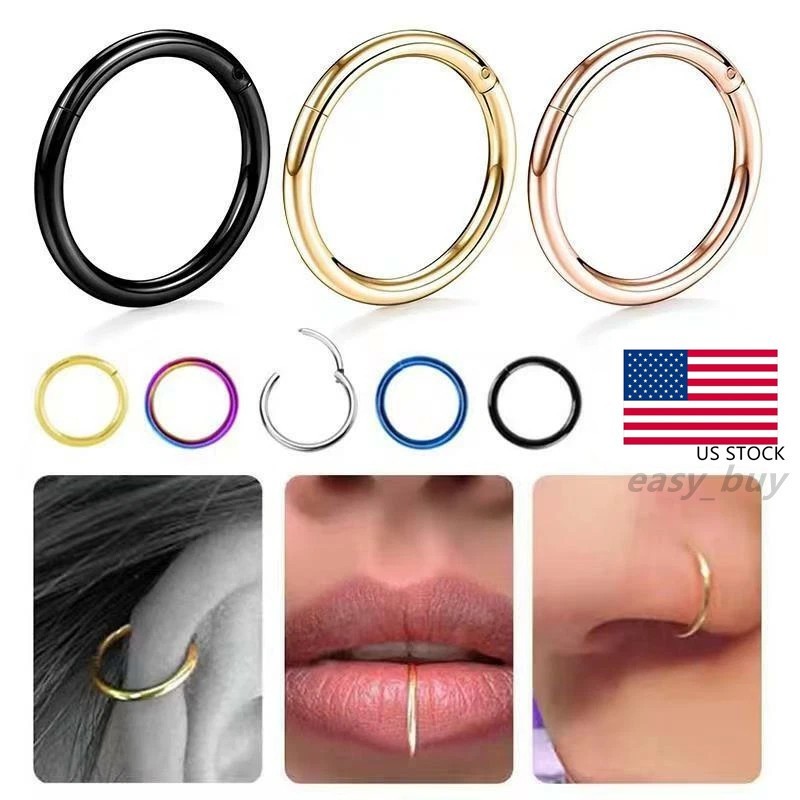

Photos from current listings. Actual item, color, and included accessories may vary.
Nose Ring Buying Guide
Nose rings range from thin 20G fashion hoops to implant-grade titanium seamless rings, where the key trade-off is material purity and closure mechanism versus cost and ease of insertion. The decisive rule: choose implant-grade titanium (ASTM F136) or surgical steel (316L) with a secure hinge or bead closure for healing piercings, and accept only 316L or better for daily wear; avoid mystery-metal alloys that corrode and irritate.
Key takeaways
- Gauge determines comfort and healing: 20G (0.8mm) is standard for nostril studs and thin hoops; 18G (1.0mm) and 16G (1.2mm) suit septum and healed nostril piercings with less migration.
- Implant-grade titanium (ASTM F136) is nickel-free and the safest for new piercings; 316L surgical steel contains 8-12% nickel and is acceptable only for healed, non-sensitive skin.
- Hinged segment rings use a spring-loaded clicker with no loose bead, making them secure for septum and nostril wear; continuous seamless rings require bending pliers and are not for frequent changes.
At a glance
- Category
- Body Jewelry
- Last updated
- Nov 28, 2026
Current offers
Highlights
- Gauge determines comfort and healing: 20G (0.8mm) is standard for nostril studs and thin hoops; 18G (1.0mm) and 16G (1.2mm) suit septum and healed nostril piercings with less migration.
- Implant-grade titanium (ASTM F136) is nickel-free and the safest for new piercings; 316L surgical steel contains 8-12% nickel and is acceptable only for healed, non-sensitive skin.
- Hinged segment rings use a spring-loaded clicker with no loose bead, making them secure for septum and nostril wear; continuous seamless rings require bending pliers and are not for frequent changes.
- Internal diameter (ID) must match anatomy: 6mm suits most nostril and small septum piercings; 8mm and 10mm fit larger septums or stretched piercings, while 5mm is for petite nostril studs.
Best use cases
- Best fit: a 20G 6mm hinged segment ring in ASTM F136 titanium for a new nostril piercing — nickel-free, secure closure, and correct diameter for standard anatomy.
- Best fit: an 18G 8mm 316L surgical steel seamless ring for a healed septum piercing on non-sensitive skin — durable and low-profile for daily wear.
- Wrong fit: buying a 16G 10mm hoop for a fresh nostril piercing — the larger gauge and diameter increase movement and irritation risk; start with 20G 6mm.
- Skip: mystery-metal alloy 'sleeper' hoops for any piercing — they pit and release nickel; spend the small upgrade to 316L or titanium.
Buying tips
- Measure your piercing's current jewelry: if it is 20G (0.8mm) wire and 6mm inner diameter, order exactly that gauge and ID — upsizing gauge before fully healed causes trauma.
- For septum piercings, choose a hinge or clicker in 16G or 18G with 8mm ID; 6mm can pinch the septum and 10mm may hang too low for daily comfort.
- Match closure to lifestyle: hinged segment rings for easy daily changes, seamless rings for set-and-forget wear, and nostril screws or L-bends only for healed nostril piercings.
- Verify material marking: 'ASTM F136' titanium or '316L' steel; avoid 'surgical steel' without grade, which often means 304 or mystery alloy with higher nickel release.
Specs
| Gauge | 20G / 18G / 16G (0.8-1.2mm) |
|---|---|
| Material Grade | ASTM F136 Ti / 316L steel |
| Inner Diameter | 6mm / 8mm / 10mm |
| Closure Type | Hinged / Seamless / Screw |
Related searches
What to check before buying
- Confirm your piercing gauge with a caliper or your piercer: 20G (0.8mm), 18G (1.0mm), or 16G (1.2mm) — ordering the wrong gauge risks irritation or migration.
- Measure inner diameter of your current jewelry or ask your piercer: 6mm for nostril, 8-10mm for septum, to ensure the ring sits flush without pinching.
- Check for nickel sensitivity: if you react to cheap earrings, choose ASTM F136 titanium only; 316L steel still contains nickel.
- Ensure the closure type suits your dexterity and healing stage: hinged rings are easiest to open; seamless rings require a bending tool and are not for fresh piercings.
FAQ
Data sources: eBay / Amazon listings and product attribute feeds. Updated Nov 28, 2026.
Some links on this page are affiliate links. If you buy after clicking one, we may earn a commission at no extra cost to you. This does not change which products appear here or their order. Affiliate disclosure.