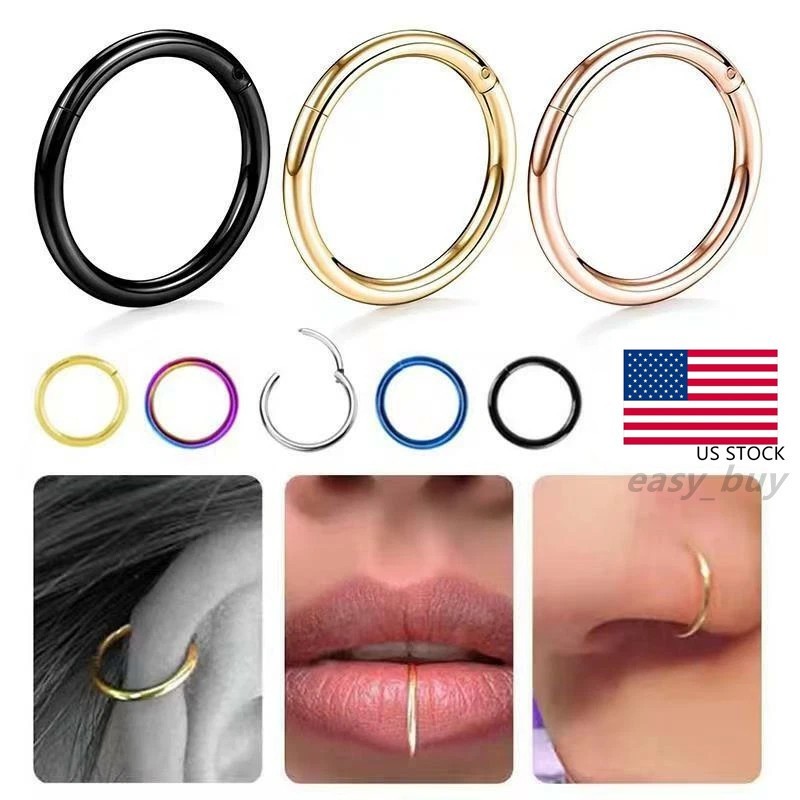

Photos from current listings. Actual item, color, and included accessories may vary.
Nose Ring With Back Buying Guide
A nose ring with back is a body-piercing retainer or hoop that adds a secure backing element—often a hinged segment, flat disk, or screw-on ball—to prevent the jewelry from slipping out of the nostril. The core trade-off is between secure retention and comfort: backing mechanisms add safety but can snag or irritate if the gauge, diameter, or material finish is wrong. The decision rule is simple: pick implant-grade titanium or surgical steel with a smooth, seamlessly closing mechanism for fresh or sensitive piercings, and only choose decorative backings or larger gauges once the piercing is fully healed.
Key takeaways
- Hinged segment rings use a spring-loaded clicker mechanism that opens wide and snaps closed flush—no exposed hinge edges to catch on tissue when properly sized.
- Surgical steel (316L) is the standard budget alloy; implant-grade titanium (Ti-6Al-4V, ASTM F136) is lighter and nickel-free for sensitive skin.
- Standard nose gauge is 20G (0.8 mm) for nostril studs and 18G (1.0 mm) or 16G (1.2 mm) for hoops and septum rings—match the gauge to the existing piercing.
At a glance
- Category
- Body Jewelry
- Last updated
- Nov 28, 2026
Current offers
Highlights
- Hinged segment rings use a spring-loaded clicker mechanism that opens wide and snaps closed flush—no exposed hinge edges to catch on tissue when properly sized.
- Surgical steel (316L) is the standard budget alloy; implant-grade titanium (Ti-6Al-4V, ASTM F136) is lighter and nickel-free for sensitive skin.
- Standard nose gauge is 20G (0.8 mm) for nostril studs and 18G (1.0 mm) or 16G (1.2 mm) for hoops and septum rings—match the gauge to the existing piercing.
- A backing element (flat disk, ball end, or hinged closure) secures the ring inside the nostril; diameter from 6 mm to 10 mm changes how snugly the hoop hugs the nostril.
Best use cases
- Best fit: choose a hinged segment hoop in 20G or 18G implant-grade titanium for a healed nostril piercing—the flush clicker closes securely and the smooth surface minimizes irritation.
- Best fit: pick a flat-back labret-style stud or screw-on ball backing for high-movement activities (sports, swimming) where a loose hoop could be lost or snagged.
- Wrong fit to skip: avoid decorative or oversized backings on a fresh piercing—crust formation and swelling need smooth, simple jewelry with room for cleaning.
- Wrong fit to skip: skip 16G or thicker hoops in a nostril unless the piercing was originally stretched—forcing thicker jewelry through a 20G hole causes micro-tears.
Buying tips
- Match the gauge exactly: 20G (0.8 mm) for standard nostril studs, 18G (1.0 mm) for most nose hoops, 16G (1.2 mm) for septum and stretched nostril piercings—never force a thicker gauge through a smaller hole.
- Choose implant-grade titanium (ASTM F136) or 316L surgical steel for the shaft; avoid nickel-containing alloys or plated brass, which tarnish and release irritants in a piercing.
- Measure the hoop diameter against your nostril: 6–7 mm sits close to the nostril crease, 8–10 mm gives a looser, more visible hoop—a larger diameter on a small nostril can catch on tissues.
- For hinged rings, check that the closure is seamless and the hinge pin is flush when closed; a protruding hinge edge is the most common cause of irritation and snagging.
Specs
| Gauge | 20G (0.8 mm) / 18G (1.0 mm) / 16G (1.2 mm) |
|---|---|
| Material | ASTM F136 Titanium or 316L Steel |
| Backing Type | Hinged clicker / Flat disk / Screw ball |
| Hoop Diameter | 6–10 mm (nostril fit range) |
Related searches
What to check before buying
- Confirm your piercing gauge (20G, 18G, or 16G) with a caliper or piercer—buying the wrong gauge is the top cause of returns and irritation.
- Measure your nostril from the piercing hole to the outer edge to pick a hoop diameter that clears the tissue without pressing into it (6–7 mm close fit, 8–10 mm relaxed fit).
- Check material certification on the listing or packaging: look for ASTM F136 titanium or 316L surgical steel; avoid vague 'steel alloy' or plated finishes.
- Ensure the backing mechanism (hinged clicker, flat disk, or screw ball) is smooth and fully closed—run a fingertip along the seam to detect any sharp edge before inserting.
FAQ
Data sources: eBay / Amazon listings and product attribute feeds. Updated Nov 28, 2026.
Some links on this page are affiliate links. If you buy after clicking one, we may earn a commission at no extra cost to you. This does not change which products appear here or their order. Affiliate disclosure.