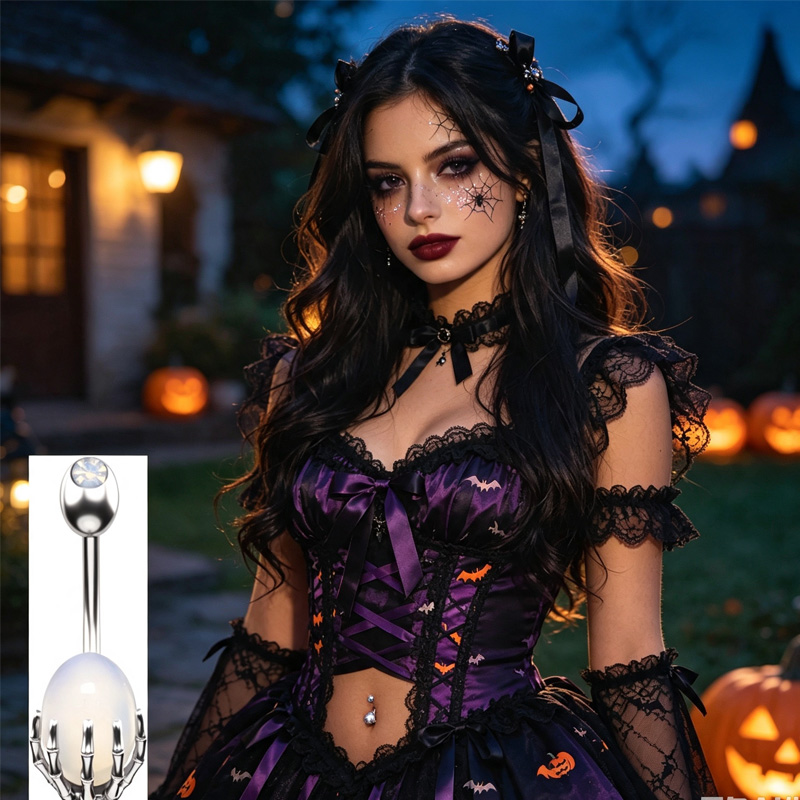

Photos from current listings. Actual item, color, and included accessories may vary.
Opal Belly Button Ring Buying Guide
An opal belly button ring is a curved barbell navel piercing whose decorative top features a synthetic or lab-created opal cabochon, typically mounted in 316L stainless steel or implant-grade titanium. The core trade-off is stone security and metal biocompatibility: prong-set opals in plated brass lose stones and corrode, while bezel-set opals in 316L steel or ASTMF-136 titanium survive daily wear. Choose bezel-set, 14G, internally threaded or press-fit titanium for healed piercings; skip prong-set fashion pieces for anything but short-term costume use.
Key takeaways
- Standard navel barbell gauge is 14G (1.6 mm), with 3/8-inch (10 mm) and 7/16-inch (11 mm) lengths covering most healed navel anatomy.
- 316L surgical steel is the minimum corrosion-resistant grade; ASTMF-136 titanium is lighter and nickel-safe for sensitive skin.
- Bezel-set opals mechanically lock the cabochon under a metal lip; prong settings snag on clothing and shed stones within months.
At a glance
- Category
- Body Jewelry
- Last updated
- Nov 28, 2026
Current offers
Highlights
- Standard navel barbell gauge is 14G (1.6 mm), with 3/8-inch (10 mm) and 7/16-inch (11 mm) lengths covering most healed navel anatomy.
- 316L surgical steel is the minimum corrosion-resistant grade; ASTMF-136 titanium is lighter and nickel-safe for sensitive skin.
- Bezel-set opals mechanically lock the cabochon under a metal lip; prong settings snag on clothing and shed stones within months.
- Synthetic opal (silica glass with resin) offers consistent play-of-color; lab-created opal is more porous and yellows with chlorine exposure.
Best use cases
- Best fit: healed navel piercings needing daily wear — pick a 14G bezel-set 316L steel or titanium barbell with a 5-6 mm opal cabochon.
- Best fit: costume or party looks (Halloween skeleton-claw styles) — choose prong-set plated pieces knowingly as short-wear fashion, not daily jewelry.
- Wrong fit: fresh or healing piercings — skip opal-set tops entirely; use plain implant-grade titanium barbells until fully healed (6-12 months).
- Wrong fit: active swimmers or hot-tub users — skip resin-based synthetic opals, which cloud and discolor with chlorine; choose sealed glass or titanium-set stones.
Buying tips
- Match barbell length to anatomy: 3/8 in (10 mm) for standard navels, 7/16 in (11 mm) if the navel collapses or sits deep; too-short bars cause migration.
- Confirm 14G (1.6 mm) gauge; 16G navel jewelry is too thin for the tissue and raises rejection risk in most navels.
- Choose bezel or closed settings over prongs — prongs catch on waistbands and are the leading cause of lost opal stones.
- Prefer internally threaded or threadless (press-fit) tops over externally threaded; external threads scrape the piercing channel on insertion.
Specs
| Gauge | 14G (1.6 mm) standard |
|---|---|
| Barbell Length | 3/8 in (10 mm) / 7/16 in (11 mm) |
| Metal Grade | 316L steel / ASTMF-136 titanium |
| Setting Type | Bezel-set vs prong-set |
Related searches
What to check before buying
- Measure your current barbell length (10 mm vs 11 mm) and navel depth before ordering; a too-long bar tilts and irritates.
- Confirm metal grade: look for 316L steel or ASTMF-136 titanium stamping; plated brass and zinc alloys discolor within weeks.
- Check the setting type in product photos: bezel-set opals have a visible metal rim; prong-set have visible claws.
- Verify the opal size fits your navel's skin fold — 5-6 mm cabochons sit flush; 8 mm+ tops can press against waistbands.
FAQ
Data sources: eBay / Amazon listings and product attribute feeds. Updated Nov 28, 2026.
Some links on this page are affiliate links. If you buy after clicking one, we may earn a commission at no extra cost to you. This does not change which products appear here or their order. Affiliate disclosure.