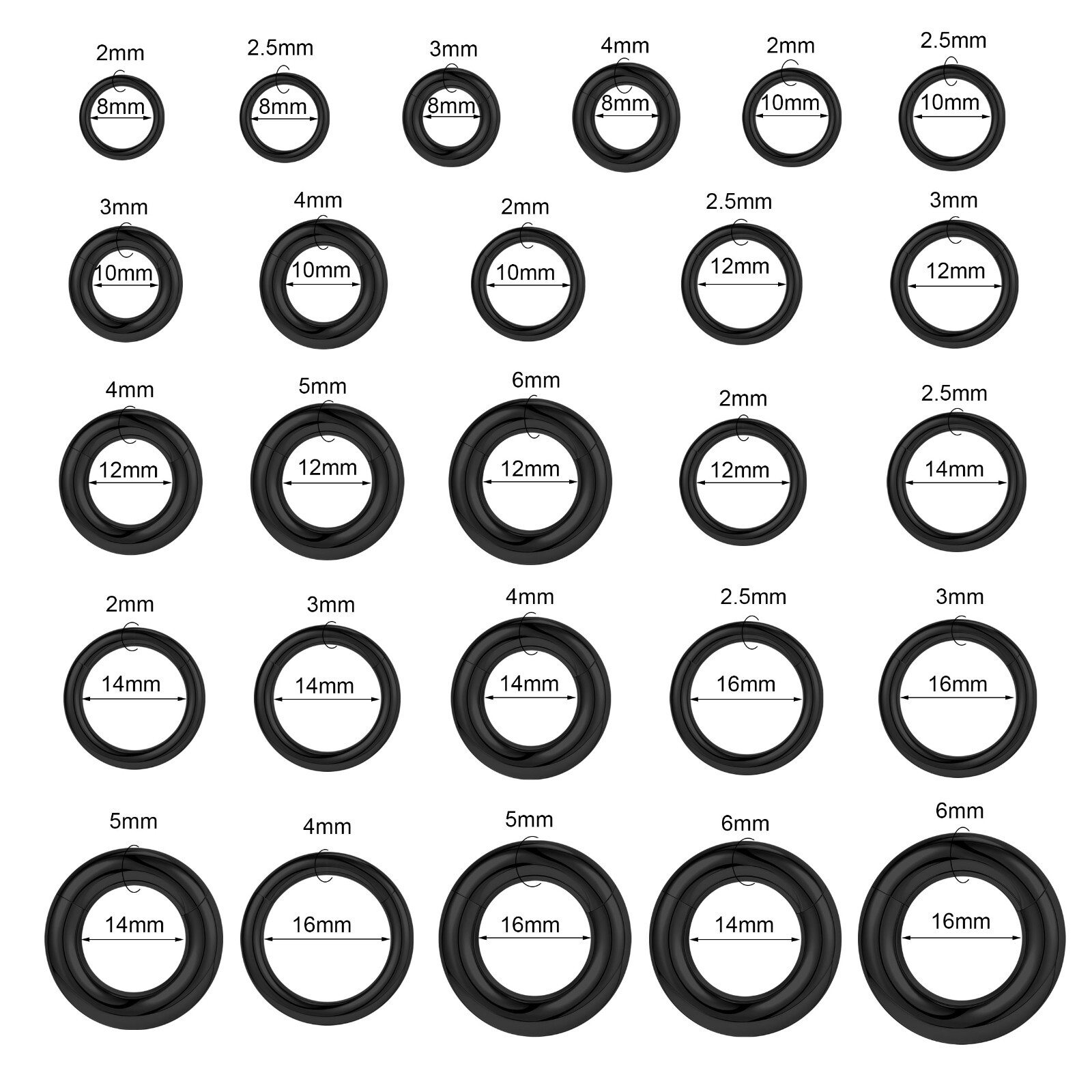

Photos from current listings. Actual item, color, and included accessories may vary.
Titanium Ear Jewelry Buying Guide
Titanium ear jewelry is body-safe, implant-grade metal for piercings, defined by material purity (ASTM F136 Ti-6Al-4V ELI vs cheaper G23 or surgical steel) and precision threading or hinge mechanisms. The core trade-off is certified biocompatibility and corrosion resistance versus lower-cost alloys that may contain nickel. Choose ASTM F136 or F67 titanium with a verified gauge and wearable length; skip any listing lacking alloy grade and finish details.
Key takeaways
- Implant-grade titanium is ASTM F136 (Ti-6Al-4V ELI) or ASTM F67 (commercially pure); both are nickel-free and safe for fresh piercings.
- Gauge sizing follows Brown & Sharpe: 20G=0.8mm, 18G=1.0mm, 16G=1.2mm, 14G=1.6mm, 12G=2.0mm, 10G=2.4mm, 8G=3.2mm, 6G=4.0mm, 4G=5.0mm, 2G=6.0mm.
- Hinged clicker mechanisms use a spring-loaded bar; verify the hinge is titanium (not stainless) and that the clicker closes with an audible snap for security.
At a glance
- Category
- Body Jewelry
- Last updated
- Nov 28, 2026
Current offers
Highlights
- Implant-grade titanium is ASTM F136 (Ti-6Al-4V ELI) or ASTM F67 (commercially pure); both are nickel-free and safe for fresh piercings.
- Gauge sizing follows Brown & Sharpe: 20G=0.8mm, 18G=1.0mm, 16G=1.2mm, 14G=1.6mm, 12G=2.0mm, 10G=2.4mm, 8G=3.2mm, 6G=4.0mm, 4G=5.0mm, 2G=6.0mm.
- Hinged clicker mechanisms use a spring-loaded bar; verify the hinge is titanium (not stainless) and that the clicker closes with an audible snap for security.
- Internal thread (threads inside the post) reduces tissue irritation versus external thread; look for 'internally threaded' or 'threadless' push-fit designs.
Best use cases
- Best fit: Fresh or healing cartilage, lobe, septum, or nostril piercings — choose ASTM F136 internally threaded flat-back labrets or seamless rings in 16G–18G.
- Best fit: Stretched lobes or septum (2G–12G) — select single-flare or screw-fit titanium tunnels/plugs with a wearable length 1–2mm longer than tissue thickness.
- Wrong fit: Anyone with known nickel allergy should avoid 'surgical steel' or 'titanium-coated' jewelry; only uncoated ASTM F136/F67 is safe.
- Skip: Externally threaded barbells or clickers with stainless steel hinges for fresh piercings — they trap bacteria and increase irritation risk.
Buying tips
- Match gauge to piercing age: 18G/16G for initial lobe/cartilage, 14G for septum or industrial, 12G–2G only for fully healed stretches.
- For flat-back labrets, measure wearable length as post length minus 2mm for swelling; standard 6mm fits most lobes, 8mm for cartilage.
- Verify alloy: 'Ti-6Al-4V ELI' or 'ASTM F136' on the listing; 'G23' is lower-grade and not implant-certified.
- Choose threadless (push-fit) for easy changes and lower irritation; choose internally threaded for maximum security in high-movement areas.
Specs
| Alloy Grade | ASTM F136 / F67 implant-grade |
|---|---|
| Gauge Range | 20G–2G (0.8mm–6.0mm) |
| Thread Type | Internal / Threadless push-fit |
| Closure Style | Hinged clicker / Ball / Segment |
Related searches
What to check before buying
- Confirm your piercing gauge with a caliper or piercer — jewelry in the wrong gauge (e.g., 16G in a 14G hole) will migrate or fall out.
- Measure tissue thickness at the piercing site for hoop diameter or plug wearable length; add 1–2mm for healing swell.
- Check hinge or clasp closure type: clicker, segment ring, or ball closure — each requires different insertion technique.
- Verify the finish is mirror-polish or bead-blasted (both biocompatible); avoid painted or PVD-coated titanium for fresh piercings.
FAQ
Data sources: eBay / Amazon listings and product attribute feeds. Updated Nov 28, 2026.
Some links on this page are affiliate links. If you buy after clicking one, we may earn a commission at no extra cost to you. This does not change which products appear here or their order. Affiliate disclosure.