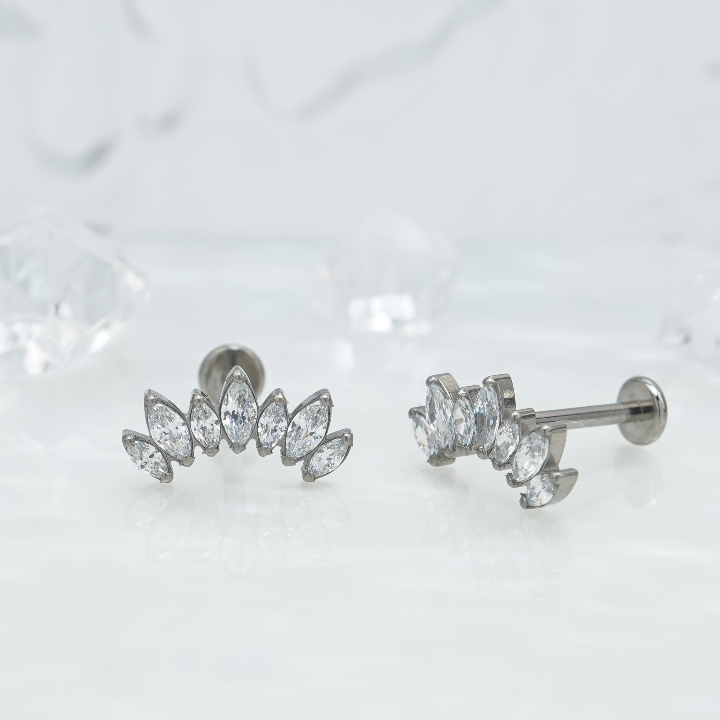

Photos from current listings. Actual item, color, and included accessories may vary.
Titanium Labret Jewelry Buying Guide
Titanium labret jewelry is a straight-bar stud (flat-back or ball-back) used for lip, monroe, medusa, labret, and ear piercings, where the decisive trade-off is implant-grade material purity versus low-cost mystery alloys that cause irritation and fading. The clear rule: choose ASTM F136 titanium (Ti-6Al-4V ELI) or ASTM F67 commercially pure titanium with a mirror-polished finish and internally threaded or threadless ends—anything labeled 'surgical steel' or 'titanium alloy' without a standard is a compromise.
Key takeaways
- ASTM F136 Ti-6Al-4V ELI is the implant-grade standard for body jewelry; ASTM F67 commercially pure titanium is softer and best for initial piercings, while generic 'titanium' lacks guaranteed biocompatibility.
- Threadless (push-fit) and internally threaded labrets eliminate exposed threads that scratch fistula tissue; externally threaded bars are a durability and healing compromise.
- Gauge sets fit: 16G (1.2 mm) for standard ear/cartilage, 14G (1.6 mm) for lip/labret/medusa, 12G (2 mm) for stretched or initial tongue; bar length must exceed swelling allowance by 2–3 mm.
At a glance
- Category
- Body Jewelry
- Last updated
- Nov 28, 2026
Current offers
Highlights
- ASTM F136 Ti-6Al-4V ELI is the implant-grade standard for body jewelry; ASTM F67 commercially pure titanium is softer and best for initial piercings, while generic 'titanium' lacks guaranteed biocompatibility.
- Threadless (push-fit) and internally threaded labrets eliminate exposed threads that scratch fistula tissue; externally threaded bars are a durability and healing compromise.
- Gauge sets fit: 16G (1.2 mm) for standard ear/cartilage, 14G (1.6 mm) for lip/labret/medusa, 12G (2 mm) for stretched or initial tongue; bar length must exceed swelling allowance by 2–3 mm.
- PVD-coated colors (gold, rose gold, black) are cosmetic surface layers; uncoated polished titanium is the only fully scratch- and fade-proof option for long-term wear.
Best use cases
- Best fit: fresh lip, medusa, or monroe piercing—pick 14G ASTM F67 or F136 titanium with 10–12 mm bar length and flat disc back to allow swelling; skip externally threaded or coated bars.
- Best fit: healed cartilage or lobe piercing—choose 16G threadless ASTM F136 labret with 6–8 mm post and 3–4 mm top; skip 14G unless the piercing was originally stretched.
- Wrong fit to avoid: active swimmers or gym-goers buying PVD-coated or 'surgical steel' labrets—coating chips and nickel leaches; choose uncoated implant-grade titanium with secure threadless fit.
- Wrong fit to avoid: using a labret bar as a nose ring or eyebrow curved barbell—straight bars migrate and reject in curved piercings; match jewelry geometry to piercing channel.
Buying tips
- Verify the mill certificate or stamp: ASTM F136 or F67 must appear on the listing or packaging; 'surgical steel' (316L) contains nickel and is not implant-grade for fresh piercings.
- Calculate bar length: measure piercing channel and add 2 mm for healed jewelry, 3–4 mm for fresh swelling; a too-short bar embeds and a too-long bar snags.
- Match thread type to lifestyle: threadless ends swap tops quickly but require firm push-fit; internally threaded bars are secure for high-movement lip and monroe placements.
- Choose polished mirror finish over matte or anodized for fresh piercings—micro-scratches in matte finishes harbor bacteria; anodized colors are oxide layers that can fade with harsh cleaners.
Specs
| Material Standard | ASTM F136 vs F67 titanium |
|---|---|
| Thread Type | Threadless / internally threaded |
| Gauge Range | 16G (1.2 mm) to 12G (2 mm) |
| Bar Length | 6–12 mm (swelling allowance +2–3 mm) |
Related searches
What to check before buying
- Confirm your piercing gauge with a caliper or piercer: 16G (1.2 mm), 14G (1.6 mm), or 12G (2 mm)—buying the wrong gauge forces re-piercing or stretching.
- Measure the top disc or ball diameter: 3–4 mm suits lip and medusa; 5–6 mm is visible statement jewelry and can irritate gums if placed intraorally.
- Check jewelry compatibility: threadless pins require matching gauge and post diameter; internally threaded ends need the same thread pitch (commonly 1.2 mm for 16G, 1.6 mm for 14G).
- Assess cleaning routine: uncoated titanium tolerates alcohol and saline; PVD coatings degrade with abrasive cleaners, so choose uncoated for daily saline soaks.
FAQ
Data sources: eBay / Amazon listings and product attribute feeds. Updated Nov 28, 2026.
Some links on this page are affiliate links. If you buy after clicking one, we may earn a commission at no extra cost to you. This does not change which products appear here or their order. Affiliate disclosure.