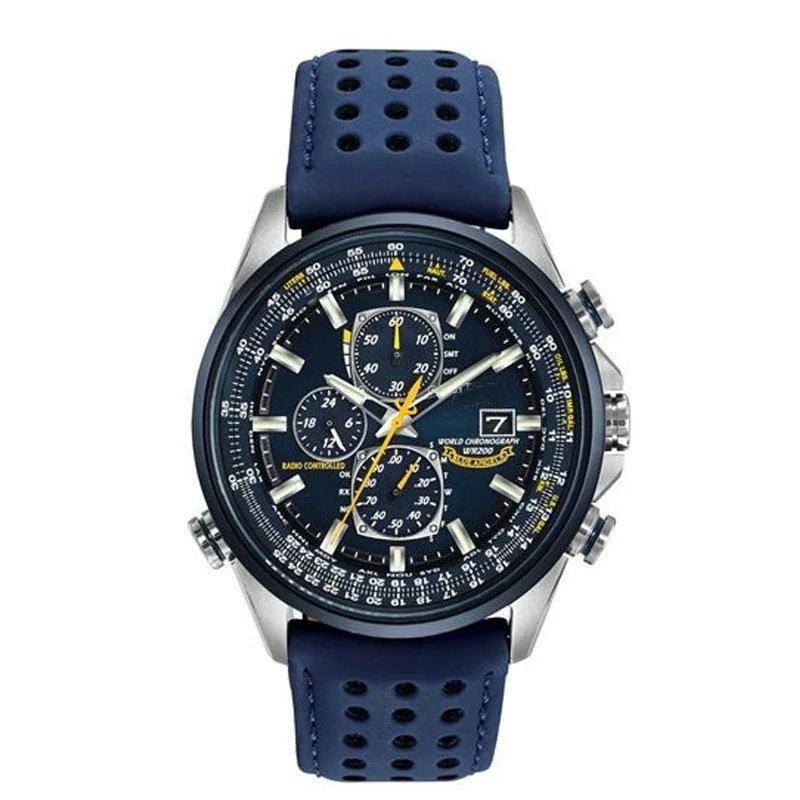

Photos from current listings. Actual item, color, and included accessories may vary.
Aviation Watches Buying Guide
Aviation watches are legibility-first pilot tools defined by high-contrast dials, large crowns, and often slide-rule bezels or GMT complications. The core trade-off is mechanical movement (hand-wind or automatic, requiring service every 3–5 years) versus quartz (battery-powered, far more shock-tolerant and accurate for daily wear). Choose mechanical only if you value heritage and don't mind periodic service; choose quartz or solar if you want a grab-and-go pilot that survives cockpit vibration and hard knocks.
Key takeaways
- Hand-wind mechanical movements (typical 40-hour power reserve) are the classic aviator spec but demand daily winding and 3–5 year servicing; quartz alternatives offer ±15 sec/month accuracy with no winding discipline.
- True pilot watches use 12-hour bezels or slide-rule (E6B) bezels for flight-time and fuel calculations; GMT models add a fourth hand tracking a second time zone at a glance.
- Stainless steel cases and bracelets (316L grade) resist cockpit moisture and sweat; sapphire crystal is the durability benchmark versus mineral glass, which scratches under cockpit abuse.
At a glance
- Category
- Wristwatches
- Last updated
- Nov 28, 2026
Current offers
Highlights
- Hand-wind mechanical movements (typical 40-hour power reserve) are the classic aviator spec but demand daily winding and 3–5 year servicing; quartz alternatives offer ±15 sec/month accuracy with no winding discipline.
- True pilot watches use 12-hour bezels or slide-rule (E6B) bezels for flight-time and fuel calculations; GMT models add a fourth hand tracking a second time zone at a glance.
- Stainless steel cases and bracelets (316L grade) resist cockpit moisture and sweat; sapphire crystal is the durability benchmark versus mineral glass, which scratches under cockpit abuse.
- Aviation legibility hinges on high-contrast lume (C3 or BGW9 Super-LumiNova) and oversized hands; 38–42mm cases suit most wrists, while 44mm+ is reserved for oversized flieger styles.
Best use cases
- Best fit for daily cockpit or desk-pilot use: pick a 38–42mm stainless steel automatic with sapphire crystal and a 12-hour or GMT bezel—durable, legible, and serviceable.
- Wrong fit: buying a hand-wind mechanical as a single do-everything watch if you won't commit to daily winding and periodic servicing—choose a quartz or solar pilot instead.
- Best fit for a vintage flieger look on a small wrist: a 38–40mm Type B dial with a sterile or minimal logo layout and a long leather strap for over-flight-suit wear.
- Wrong fit: a 44mm+ oversized pilot on a sub-7-inch wrist—it will overhang the wrist edge and catch on cuffs; stay at or below 42mm unless you have a 7.5-inch+ wrist.
Buying tips
- Match case diameter to wrist circumference: 6.0–6.5 in wrists take 36–39mm, 6.5–7.5 in take 39–42mm, and 7.5 in+ can carry 42–46mm flieger cases.
- Choose movement by discipline: hand-wind or automatic for heritage and no battery; quartz or solar for shock resistance, accuracy, and zero maintenance beyond battery/capacitor replacement.
- Demand sapphire crystal with anti-reflective coating on any pilot watch above entry tier; mineral glass is acceptable only on budget beaters where scratches are expected.
- Verify lug width before buying straps: 20mm and 22mm are the common pilot sizes; odd widths (19mm, 21mm) severely limit aftermarket strap and bracelet options.
Specs
| Movement Type | Hand-wind / Automatic / Quartz / Solar |
|---|---|
| Case Diameter | 36–46mm (flieger 39–45mm) |
| Crystal Grade | Sapphire vs Mineral glass |
| Bezel Function | 12-hour / GMT / Slide-rule / Fixed |
Related searches
What to check before buying
- Measure your wrist circumference and flat top width—confirm the case diameter and lug-to-lug length sit within your wrist before choosing an oversized flieger.
- Check the strap/bracelet length against your wrist: many pilot straps run 26cm for over-suit wear and may be too long for bare-wrist daily use without a trim.
- Confirm the movement type and service interval (mechanical) or battery/capacitor type (quartz/solar) so you know the long-term ownership routine.
- Verify water resistance matches your environment: 50m is splash-only, 100m handles rain and washing, and 200m+ is needed for swimming or water sports.
FAQ
Data sources: eBay / Amazon listings and product attribute feeds. Updated Nov 28, 2026.
Some links on this page are affiliate links. If you buy after clicking one, we may earn a commission at no extra cost to you. This does not change which products appear here or their order. Affiliate disclosure.