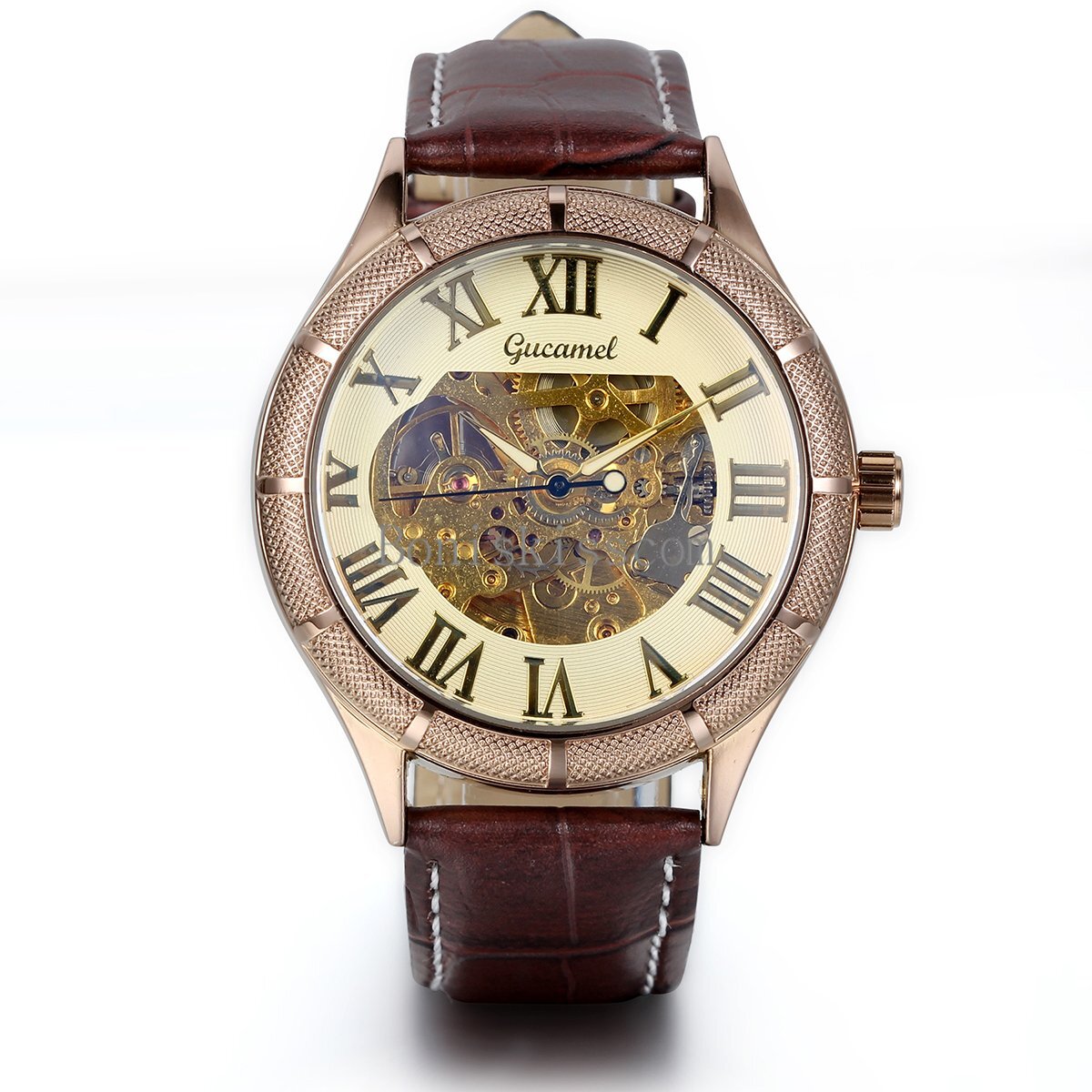

Photos from current listings. Actual item, color, and included accessories may vary.
Skeleton Watches Buying Guide
Skeleton watches expose the movement—gears, bridges, and escapement—through an open-worked dial or caseback, so the watch is judged as much on mechanics as on looks. The primary trade-off is movement grade versus finishing: a decorated automatic or hand-wound mechanical delivers real horological value, while a quartz skeleton is purely decorative. The decision rule: buy a mechanical skeleton only from a maker that names the caliber and specifies sapphire or hardened mineral crystal; treat unlabeled quartz skeletons as fashion pieces.
Key takeaways
- Movement tier decides everything: automatic (self-winding) and manual-wind mechanical skeletons show real gear trains; quartz skeletons are printed or stamped plates with a battery behind them.
- Crystal grade separates daily wear from shelf wear—sapphire resists scratches, hardened mineral (often listed as 'mineral glass') scratches within months on a skeleton whose whole appeal is the dial.
- Case finishing and open-working quality vary sharply: laser-cut stamped bridges look flat, while chamfered, brushed, and polished bridges with blued screws signal a higher-grade movement.
At a glance
- Category
- Wristwatches
- Last updated
- Nov 28, 2026
Current offers
Highlights
- Movement tier decides everything: automatic (self-winding) and manual-wind mechanical skeletons show real gear trains; quartz skeletons are printed or stamped plates with a battery behind them.
- Crystal grade separates daily wear from shelf wear—sapphire resists scratches, hardened mineral (often listed as 'mineral glass') scratches within months on a skeleton whose whole appeal is the dial.
- Case finishing and open-working quality vary sharply: laser-cut stamped bridges look flat, while chamfered, brushed, and polished bridges with blued screws signal a higher-grade movement.
- Water resistance on skeleton watches is typically modest (3–5 ATM); a screw-down crown and 10 ATM rating are the exception, not the norm, in this segment.
Best use cases
- Best fit: an office or dress rotation—pick a 38–42mm automatic skeleton on a leather strap with sapphire crystal and 3–5 ATM rating; the exposed movement is the point.
- Best fit: a first mechanical watch for someone curious about how movements work—choose a hand-wound or automatic with a named caliber and an exhibition caseback rather than an open dial alone.
- Wrong fit: swimming, showering, or gym use—skeleton cases have large openings and thin gaskets; even 5 ATM models are splash-rated at best, so buy a 10 ATM+ solid-dial sports watch instead.
- Wrong fit: a do-everything daily beater on a tight budget—quartz skeleton watches trade durability and accuracy for looks; a standard quartz or solar analog watch is the better tool.
Buying tips
- Demand a named caliber: Seiko NH-series, Miyota 8-series, Sellita SW200, or ETA 2824-derived movements are serviceable and accurate; unbranded 'mechanical' with no caliber name is a red flag.
- Check crystal spec before case size: sapphire or 'sapphire-coated' is the minimum for a watch whose dial is its entire value; plain mineral glass will haze and scratch.
- Size by wrist, not listing photos: 40mm is the skeleton sweet spot; under 38mm suits wrists under 6.5 inches, and 44mm+ cases (e.g., Invicta Objet D Art 44mm) need wrists of 7.25 inches or more.
- Read water resistance literally: 3 ATM = rain and handwashing only; 5 ATM = splashes; 10 ATM with a screw-down crown is the first tier suitable for swimming.
Specs
| Movement | Automatic / Manual / Quartz |
|---|---|
| Crystal | Sapphire vs Mineral Glass |
| Case Size | 38–44 mm typical |
| Water Resistance | 3–5 ATM (10 ATM rare) |
Related searches
What to check before buying
- Measure wrist circumference and existing watch case diameter—skeleton dials read larger, so stay at or below your current comfortable size.
- Confirm the strap lug width (commonly 20mm or 22mm) so replacement leather or steel bands are available.
- Verify the crystal material and crown type in the spec table, not the marketing title.
- For automatic skeletons, confirm whether the rotor is visible and whether hand-winding is supported, since low-activity wearers may need to wind manually.
FAQ
Data sources: eBay / Amazon listings and product attribute feeds. Updated Nov 28, 2026.
Some links on this page are affiliate links. If you buy after clicking one, we may earn a commission at no extra cost to you. This does not change which products appear here or their order. Affiliate disclosure.