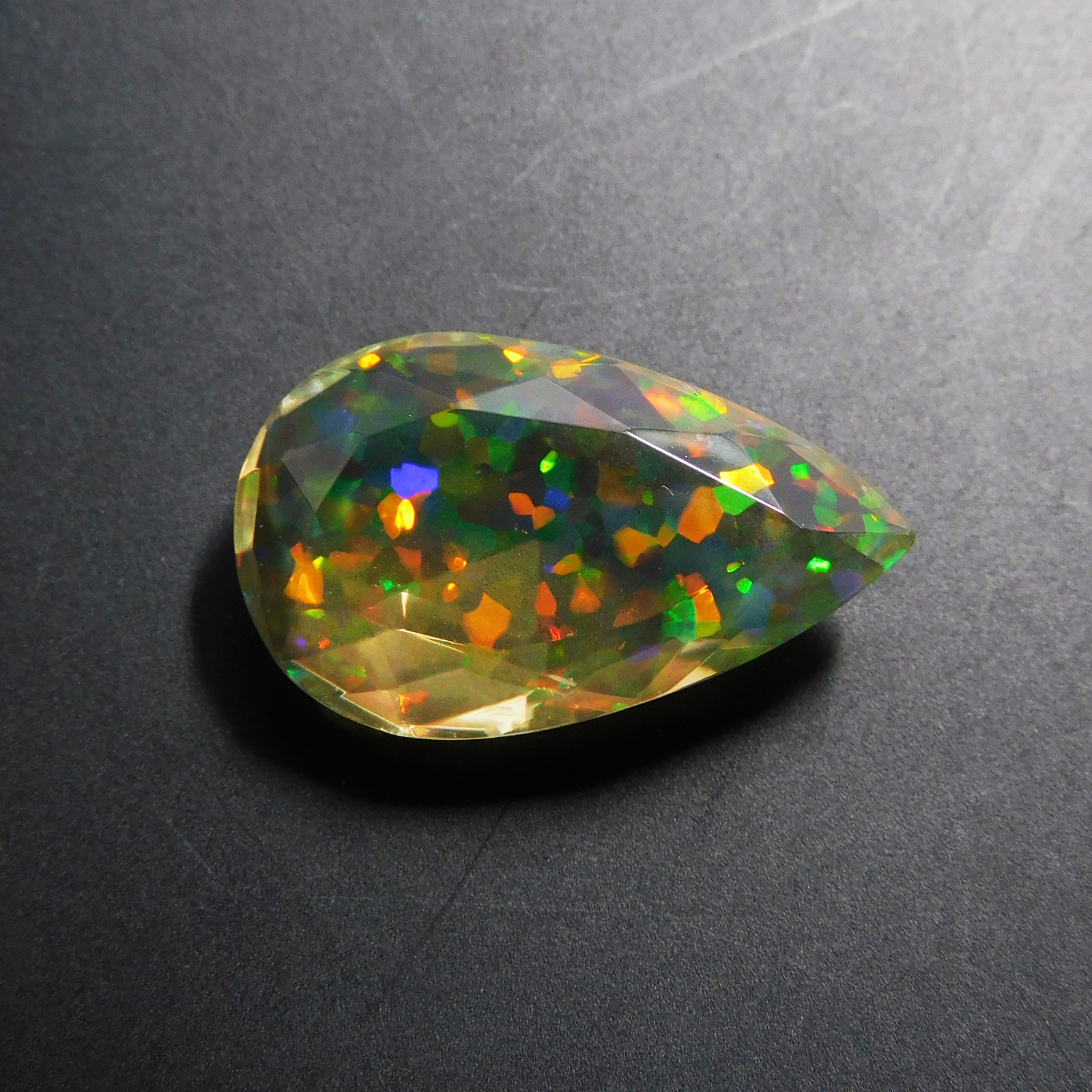

Photos from current listings. Actual item, color, and included accessories may vary.
Fire White Opal Buying Guide
Fire white opal is a natural hydrated silica gemstone where play-of-color fire flashes against a pale white or milky body tone, distinct from orange fire opal and dark black opal. The core trade-off is between natural solid opal (stable, genuine, higher cost per carat) and treated or synthetic material (cheap but prone to crazing or misrepresentation). The decision rule: buy natural solid opal with visible directional fire and a stated body tone; reject any opal listing that hides its treatment, origin, or body color.
Key takeaways
- Natural fire white opal is solid SiO2·nH2O with 5-10% water content; it must be kept hydrated and is prone to crazing if stored dry or exposed to rapid temperature swings.
- Ethiopian Welo opal (white body) typically shows broader, more diffuse play-of-color than Australian Lightning Ridge material, which tends to have sharper, pinpoint fire in a darker base.
- Doublet and triplet opals bond a thin opal slice to a dark backing or clear cap; solid white opal has no glue line and is the only tier that holds full gem value.
At a glance
- Category
- Loose Gemstones & Pearls
- Last updated
- Nov 28, 2026
Current offers
Highlights
- Natural fire white opal is solid SiO2·nH2O with 5-10% water content; it must be kept hydrated and is prone to crazing if stored dry or exposed to rapid temperature swings.
- Ethiopian Welo opal (white body) typically shows broader, more diffuse play-of-color than Australian Lightning Ridge material, which tends to have sharper, pinpoint fire in a darker base.
- Doublet and triplet opals bond a thin opal slice to a dark backing or clear cap; solid white opal has no glue line and is the only tier that holds full gem value.
- Lab-created opal replicates the silica sphere structure but is chemically identical to natural opal; it is not a simulant like glass or resin and must be labeled as synthetic, not natural.
Best use cases
- Best fit: Ethiopian Welo fire white opal rough or cabochon for jewelers cutting custom pendants and rings — choose solid natural material with visible directional fire and no fractures.
- Best fit: calibrated oval white opal parcels for standard bezel and prong settings — pick matched sizes (e.g., 6x4 mm, 8x6 mm) in solid natural opal with consistent body tone.
- Wrong fit: high-impact daily-wear rings in untreated white opal — skip natural white opal for rings that see abrasion; choose a triplet or a protected bezel setting instead.
- Wrong fit: buyers seeking vivid orange-red fire — skip white opal entirely and choose Mexican fire opal (transparent orange body) or black opal for darker contrast.
Buying tips
- Demand the body tone in writing: white opal must have a milky to pale base; a listing showing blue-green fire on a gray or black base is dark opal, not white opal.
- For calibrated settings, buy by exact millimeter dimensions (e.g., 7x5 mm, 9x7 mm) rather than carat weight, since opal density varies and carat weight alone does not guarantee fit.
- Prefer solid natural opal over doublet/triplet for investment or resale; triplets are durable but their value is a fraction of solid opal because only a thin slice is genuine.
- Check for crazing risk: avoid opal with visible surface cracks or cloudy internal fractures; Ethiopian opal is more hydrophane (absorbs water) and can change appearance temporarily when wet.
Specs
| Body Tone | White to milky base (N7-N9) |
|---|---|
| Opal Type | Solid natural vs doublet/triplet/synthetic |
| Origin | Ethiopian Welo / Australian / Mexican |
| Fire Pattern | Broad rolling vs pinpoint directional |
Related searches
What to check before buying
- Confirm the setting's exact inner dimensions in millimeters before buying a calibrated white opal cabochon; opal cannot be resized or compressed to fit.
- Verify the opal is solid natural (not doublet/triplet/synthetic) and ask for the origin region — Ethiopian, Australian, or Mexican — because body tone and fire pattern differ by source.
- Plan storage: keep white opal in a sealed bag with a damp (not wet) cotton ball to maintain humidity and prevent crazing in dry climates.
- Check that any certification (e.g., gem lab report) states 'natural opal' and 'solid' — a report listing 'assembled' or 'synthetic' means the stone is not solid natural white opal.
FAQ
Data sources: eBay / Amazon listings and product attribute feeds. Updated Nov 28, 2026.
Some links on this page are affiliate links. If you buy after clicking one, we may earn a commission at no extra cost to you. This does not change which products appear here or their order. Affiliate disclosure.