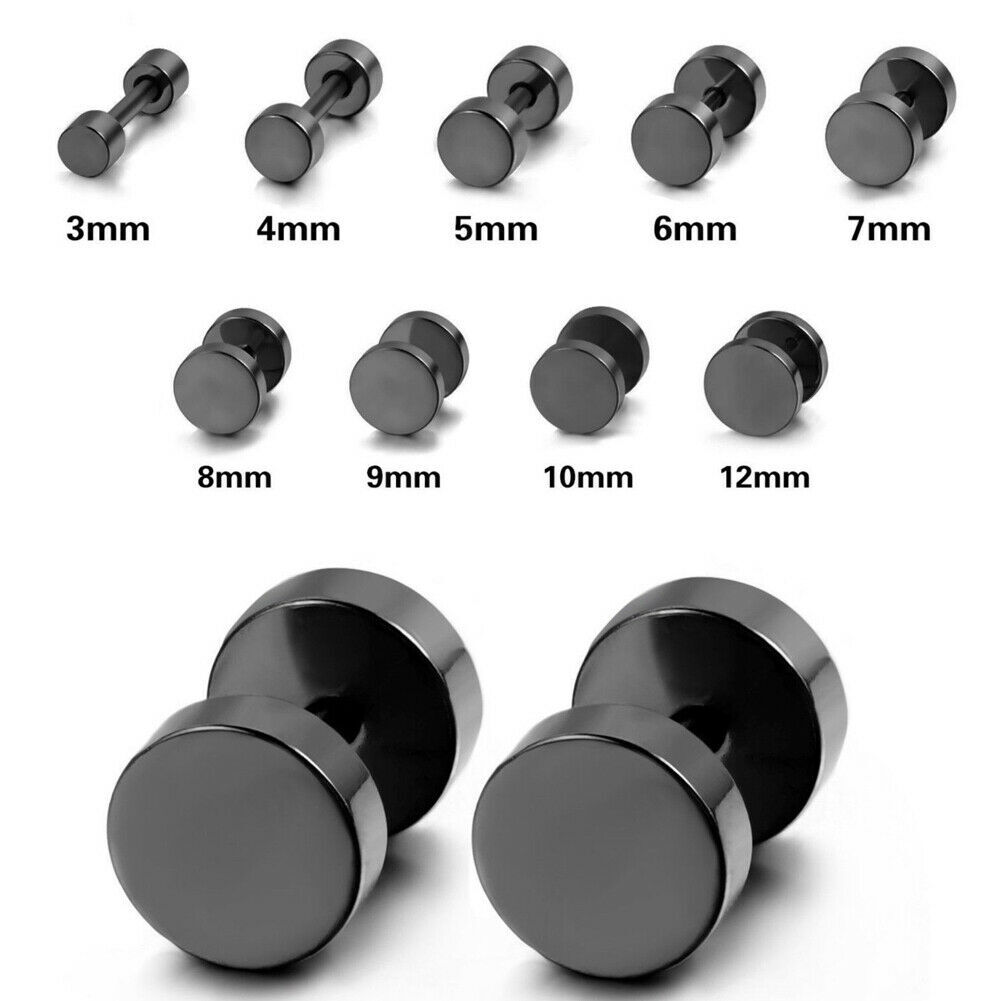

Photos from current listings. Actual item, color, and included accessories may vary.
Flat Back Stud Earring Buying Guide
Flat-back stud earrings replace the traditional butterfly clutch with a flat disc that sits flush against the skin, eliminating the pokey post that catches on hair, pillows, and phone calls. The core trade-off is metal chemistry and threading quality: implant-grade titanium and nickel-free stainless steel prevent irritation during 24/7 wear, while cheap mystery-metal posts with coarse threads strip and tarnish within weeks. The decision rule is simple—if you want to sleep, shower, and heal a new piercing in them, demand implant-grade titanium (ASTM F136) or 14k+ solid gold; if you only need occasional fashion studs, a 316L stainless or 925 sterling silver flat-back is acceptable.
Key takeaways
- Implant-grade titanium (ASTM F136, often Ti-6Al-4V ELI) is the benchmark for 24/7 wear—hypoallergenic, nickel-free, and roughly 45% lighter than surgical steel.
- Threadless (push-pin) flat-backs rely on tension-fit pins; internally threaded flat-backs use a hollow post with machine threads—never force mismatched gauges or you strip the female thread.
- Surgical stainless steel is typically 316L; it resists corrosion but still contains nickel, so it is not truly nickel-free for sensitive ears.
At a glance
- Category
- Rings & Earrings
- Last updated
- Nov 28, 2026
Current offers
Highlights
- Implant-grade titanium (ASTM F136, often Ti-6Al-4V ELI) is the benchmark for 24/7 wear—hypoallergenic, nickel-free, and roughly 45% lighter than surgical steel.
- Threadless (push-pin) flat-backs rely on tension-fit pins; internally threaded flat-backs use a hollow post with machine threads—never force mismatched gauges or you strip the female thread.
- Surgical stainless steel is typically 316L; it resists corrosion but still contains nickel, so it is not truly nickel-free for sensitive ears.
- Solid 14k gold (not gold-filled or plated) is the only gold option that won't wear through to a base metal; 14k gold-filled is a thicker bonded layer but still a non-precious core.
Best use cases
- Best fit: 24/7 sleep-and-shower earrings for healed lobe or cartilage piercings—pick implant-grade titanium threadless flat-backs with a 6–8 mm post and 3–4 mm disc.
- Best fit: New or sensitive piercings—choose ASTM F136 titanium or solid 14k gold; skip 316L stainless and any plated or gold-filled post until fully healed.
- Best fit: Cartilage, helix, and conch piercings—use a shorter 5–6 mm post with a flat 2.5–3 mm disc to avoid pressure bumps; standard 9–10 mm lobe posts will angle and irritate.
- Wrong fit: Fashion-only statement studs or heavy dangling designs—flat-backs are not designed for large stones or drop styles; choose a standard post-and-clutch or lever-back instead.
Buying tips
- Match post length to piercing site: 6–8 mm for lobes, 5–6 mm for cartilage/helix, and 4–5 mm for nostril or tragus—oversized posts tilt and cause irritation bumps.
- Check the thread standard: threadless pins need a bend-and-insert motion; internally threaded posts (often 18G or 16G) require exact gauge matching—never mix 20G pins with 18G posts.
- Prioritize solid 14k gold or ASTM F136 titanium if you have metal sensitivities; 316L stainless and gold-filled are budget tiers that can still release nickel over time.
- For sleeping comfort, choose a flat disc no wider than 4 mm on the back; larger discs press into the pillow and can embed in the skin during side-sleeping.
Specs
| Metal Grade | ASTM F136 Ti / 14k gold / 316L steel |
|---|---|
| Post Length | 4–10 mm (site-dependent) |
| Gauge | 20G / 18G / 16G standard |
| Backing Style | Flat disc (threadless or threaded) |
Related searches
What to check before buying
- Know your piercing gauge: standard lobe piercings are usually 20G or 18G; cartilage is often 16G—buy posts that match your existing jewelry gauge.
- Measure your post length with a ruler against your current earring, or use a caliper; add 1 mm for swelling if the piercing is new.
- Confirm your metal sensitivity: if you react to cheap earrings, avoid 316L stainless and gold-plated brass; choose titanium or solid 14k+ gold.
- For new piercings, verify the jewelry is sterilizable (autoclavable titanium or solid gold) and that the back disc is smooth—rough edges trap bacteria.
FAQ
Data sources: eBay / Amazon listings and product attribute feeds. Updated Nov 28, 2026.
Some links on this page are affiliate links. If you buy after clicking one, we may earn a commission at no extra cost to you. This does not change which products appear here or their order. Affiliate disclosure.