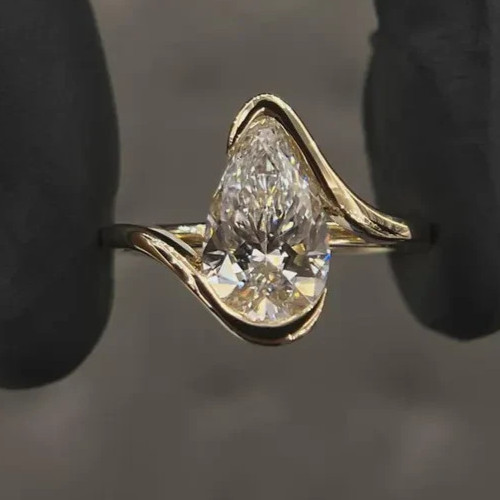

Photos from current listings. Actual item, color, and included accessories may vary.
Pear Engagement Ring Buying Guide
A pear engagement ring pairs a single pear-cut (teardrop) stone—natural diamond, lab-grown diamond, or moissanite—with a setting that must protect the pointed tip. The core trade-off is cut quality and tip security versus size for budget: a well-cut, well-set 1.0–1.5 ct pear outperforms a poorly cut 3–4 ct stone in light return and durability. The decision rule: buy GIA/IGI-certified stones with a clear table and no bow-tie, set in a V-prong or bezel tip; skip uncertified deep-cut bargains and thin six-prong settings that leave the tip exposed.
Key takeaways
- Lab-grown diamonds are chemically and optically identical to natural diamonds (same 4C grading, Mohs 10) but resell for a fraction; choice is provenance and budget, not durability.
- Pear cuts combine a brilliant-cut round end with a marquise-style point, so a bow-tie (dark band across the middle) is optical, not a flaw—reject stones with heavy bow-tie that goes black indoors.
- The pointed tip is the weakest point: V-prong, bezel, or double-claw tip settings prevent chipping; standard round prongs leave it exposed to knocks.
At a glance
- Category
- Rings & Earrings
- Last updated
- Nov 28, 2026
Current offers
Highlights
- Lab-grown diamonds are chemically and optically identical to natural diamonds (same 4C grading, Mohs 10) but resell for a fraction; choice is provenance and budget, not durability.
- Pear cuts combine a brilliant-cut round end with a marquise-style point, so a bow-tie (dark band across the middle) is optical, not a flaw—reject stones with heavy bow-tie that goes black indoors.
- The pointed tip is the weakest point: V-prong, bezel, or double-claw tip settings prevent chipping; standard round prongs leave it exposed to knocks.
- Cut grading for pears is not standardized the way round brilliants are—prioritize visual light return and a length-to-width ratio of about 1.45–1.70 for a classic teardrop.
Best use cases
- Best fit: everyday wear with active hands — choose a bezel or V-tip halo in 14k/18k gold or platinum with a 1.0–1.5 ct lab-grown certified stone for durability and value.
- Best fit: maximum finger coverage on a budget — a 2.0–4.0 ct lab-grown pear solitaire in 14k gold delivers visual size at a fraction of natural-diamond cost without sacrificing hardness.
- Wrong fit: antique or heirloom-sensitive shoppers — skip lab-grown if provenance and natural origin matter; choose a GIA-certified natural pear instead.
- Wrong fit: low-set thin-band fashion rings for daily wear — skip micro-pave bands under 1.8 mm and exposed-tip six-prong settings if the ring will face gym, garden, or travel abuse.
Buying tips
- Match stone size to ring size: a 1.0 ct pear (~9×6 mm) suits US size 4–5 hands; 1.5–2.0 ct (~10.5×7 mm) reads well on size 6–8; 3.0 ct+ (~13×8.5 mm) overwhelms fingers under size 6.
- Choose metal by wear: platinum (950) and 18k gold resist daily knocks best; 14k gold is harder than 18k and fine for most; white gold needs rhodium re-plating every 1–2 years.
- Insist on certification: GIA for natural, IGI or GIA for lab-grown; a certificate with cut/polish/symmetry grades and a plotting diagram is the minimum for any stone above 0.50 ct.
- Set the tip first: V-prong, double-claw, or bezel tip plus a gallery rail underneath prevents the pear point from chipping and stops the stone from snagging on clothing.
Specs
| Stone Type | Natural / Lab-grown diamond / Moissanite |
|---|---|
| Certification | GIA (natural) / IGI or GIA (lab-grown) |
| Tip Setting | V-prong / Bezel / Double-claw |
| Metal Purity | 14k / 18k gold / PT950 platinum |
Related searches
What to check before buying
- Measure ring size on the exact finger at room temperature (fingers swell in heat); a pear's wide end should sit across the finger, point toward the fingertip.
- Confirm the band width is at least 1.8–2.0 mm at the base for daily wear; thinner shanks bend and lose pave stones.
- Check the setting height clears your lifestyle: a high-profile pear snags on gloves and pockets; a low bezel sits flush but reduces light exposure.
- Verify metal and hallmark (14k/18k/PT950) and confirm the stone's certification number is laser-inscribed on the girdle for verification.
FAQ
Data sources: eBay / Amazon listings and product attribute feeds. Updated Nov 28, 2026.
Some links on this page are affiliate links. If you buy after clicking one, we may earn a commission at no extra cost to you. This does not change which products appear here or their order. Affiliate disclosure.